
Stories the Streets Don’t Tell
10/20/26 · Troy Osborne“Behind the quaint facades once lay hidden Mennonite congregations, meeting in attics, workshops, and, occasionally, forests outside the city walls.”
At times, the Belgian town of Bruges can feel impossibly picturesque. Its fairy-tale spires, sumptuous churches, and brick buildings with gilded gables remain so remarkably well-preserved it is no wonder that they have been designated as a UNESCO World Heritage Site.
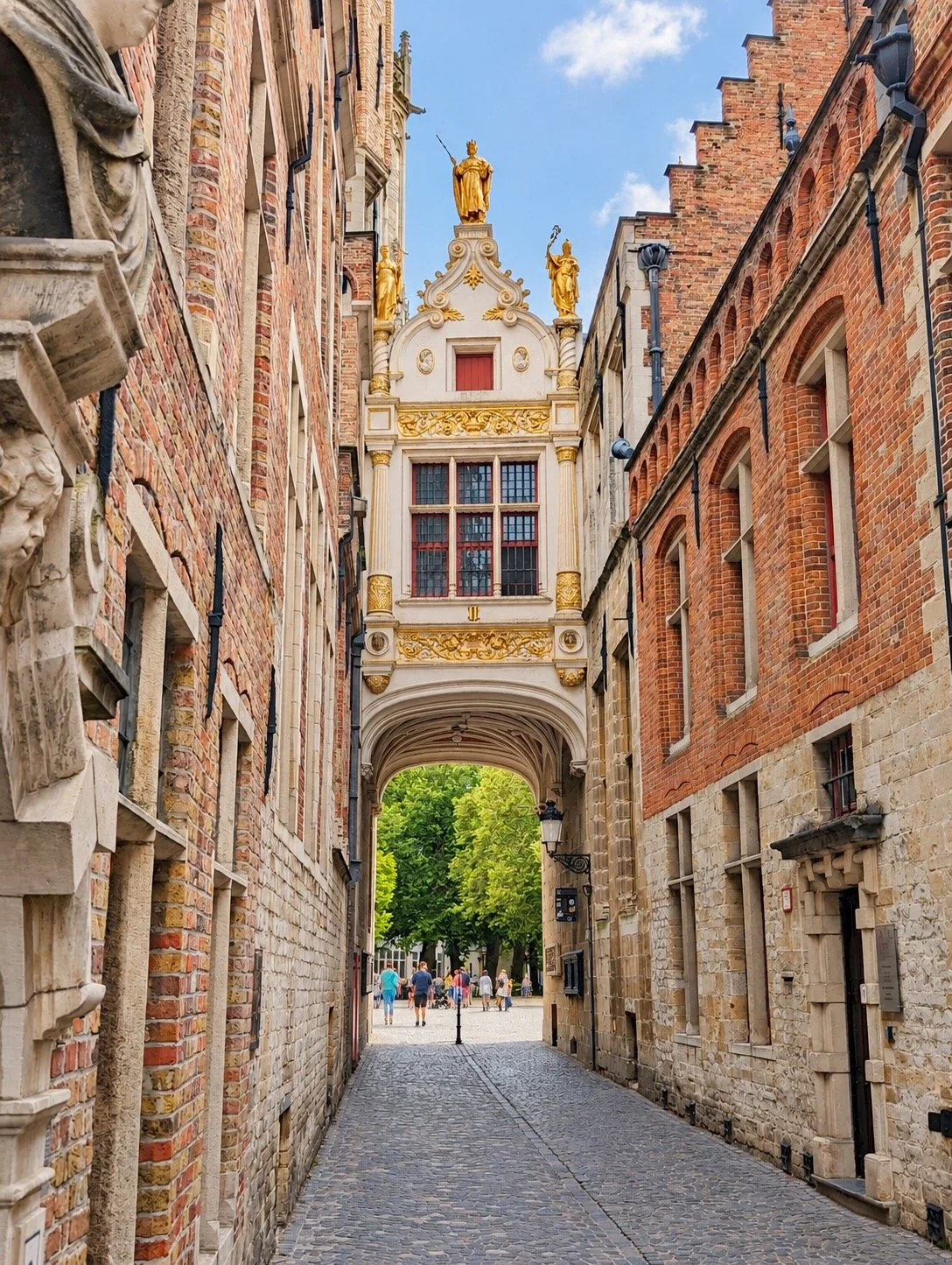
Bruges, Belgium
Bruges’s considerable charms are best experienced after the day-trippers have departed, when I wander the cobblestone back streets after nibbling on fries and mussels at a cozy café. Walking along the city’s canals accompanied by the evening’s carillon concert chiming faintly in the distance, I have one of those travel moments that cannot be contained in a museum or cathedral and cannot be captured in a photograph.
It is easy to imagine Bruges in the 1300s, when it was one of the richest cities in northwest Europe. Along with fellow Flemish towns of Ghent and Antwerp, Bruges was home to artists, bankers, and sailors who were linked to the rest of the world through extensive trade networks of canals, rivers, and ports.
In an easy stroll along the charming streets of Bruges and Antwerp, it’s easy to forget that behind the quaint facades once lay hidden Mennonite congregations, meeting in attics, workshops, and, occasionally, forests outside the city walls. In Antwerp, I wonder what it looked like through the eyes of Jan de Walle. By day, Jan worked as a ribbon cutter, but at night, he served as a deacon for the Mennonites meeting in attics or, occasionally, in larger numbers in the forest of Tillegem beyond the city walls.
As Habsburg authorities cracked down on religious dissent, Mennonites joined tens of thousands of others who used the same canals, rivers, and ports that brought so much wealth into Flanders to flee to cities where they could worship freely. The barges transporting Mennonites carried more than their faith. Artisans, merchants, artists, and publishers brought their skills and connections to the cities of the Dutch Golden Age.
Among the families who eventually settled in Haarlem and Amsterdam was the well-to-do de Neuville family, leaders of the Amsterdam congregations and, eventually, owners of a banking empire that reached from London to Hamburg.
Another Flemish refugee, Hans de Ries, fled north, after witnessing the death of friend. De Ries became a prominent leader. De Ries united the stories of Mennonite martyrs from across Europe, publishing a book that would later become the heart of the Martyrs Mirror.
The waterways of northern Europe were more than routes of escape. They became the arteries of a Mennonite world that carried merchants to markets, ministers to far-flung congregations, and letters to distant relatives. Standing beside the canals of Bruges and Haarlem, sailing the waters of the Ijsselmeer, and exploring the cosmopolitan ports of Hamburg and Lübeck, we follow the same waters that bound a scattered people together through a shared faith.
About Troy
Troy Osborne teaches European, Reformation, and Mennonite history at Conrad Grebel University College. Author of Radicals and Reformers, he brings over 30 years of travel, research, and storytelling across Europe. His passion for history, faith, and culture invites travelers to discover the people and stories behind familiar places.